| Type |
|---|
| Linear Classifier |
Good Illustration: An illustrative introduction to Fisher’s Linear Discriminant - Thalles’ blog
Find an orientation along which the projected samples are well separated.
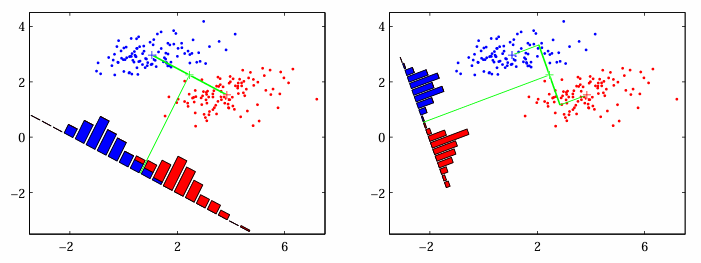
Fisher’s Linear Discriminant
- We want class means to be as far as possible. The denominator is the total within-class scatter of the projected samples.
where or is (almost like variance),
Define following matrices:
or takes the form
\begin{aligned} \begin{bmatrix} var(x_1) && cov(x_1,x_2) \ cov(x_1,x_2) && var(x_2) \end{bmatrix} \end{aligned}
$$S_B = (m_+-m_-)(m_+-m_-)^T$$ Using these we obtain, $$J(\mathbf{w}) = \frac{\vert m_+ - m_- \vert ^2}{s_+^2 + s_-^2} = \frac{\mathbf{w}^T S_B \mathbf{w}}{\mathbf{w}^T S_W \mathbf{w}}$$ $J$ is maximized when (take derivate with respect to w) $$(w^TS_Bw)S_Ww = (w^TS_Ww)S_Bw$$ Notice: - $w^TS_Ww$ and $w^TS_Bw$ are scalars, thus we get $$\alpha S_Ww = \beta S_Bw$$ - If we take $\lambda = \alpha / \beta$ we get $S_Bw=λS_Ww$ which the generalized eigenvalue problem: $$S_W^{−1}S_Bw=λw$$ From the generalized eigenvalue equation, we derive that the optimal $w$ is: $$w∝ S_W^{−1}(m_+−m_−)$$ > **Yes but how?!** > > Notice $(m_+−m_−)^Tw$ in $S_Bw=(m_+−m_−)(m_+−m_−)^Tw$ is a scalar. That means the equation looks like $S_Bw=c.(m_+−m_−)$. This shows that $S_Bw$ is always proportional to $(m_+−m_−)$ regardless of what $w$ is! Plug this into the equation above to get the generalized eigenvalue equation. To summarize, Fisher's Discriminant, - Gives the linear function with the maximum ratio of between-class scatter to within-class scatter - The problem, e.g. classification, has been reduced from a d-dimensional problem to a more manageable one-dimensional problem. - Can be extended to multiclass classification