Map of Contents
Notes
- CRISP-DM -
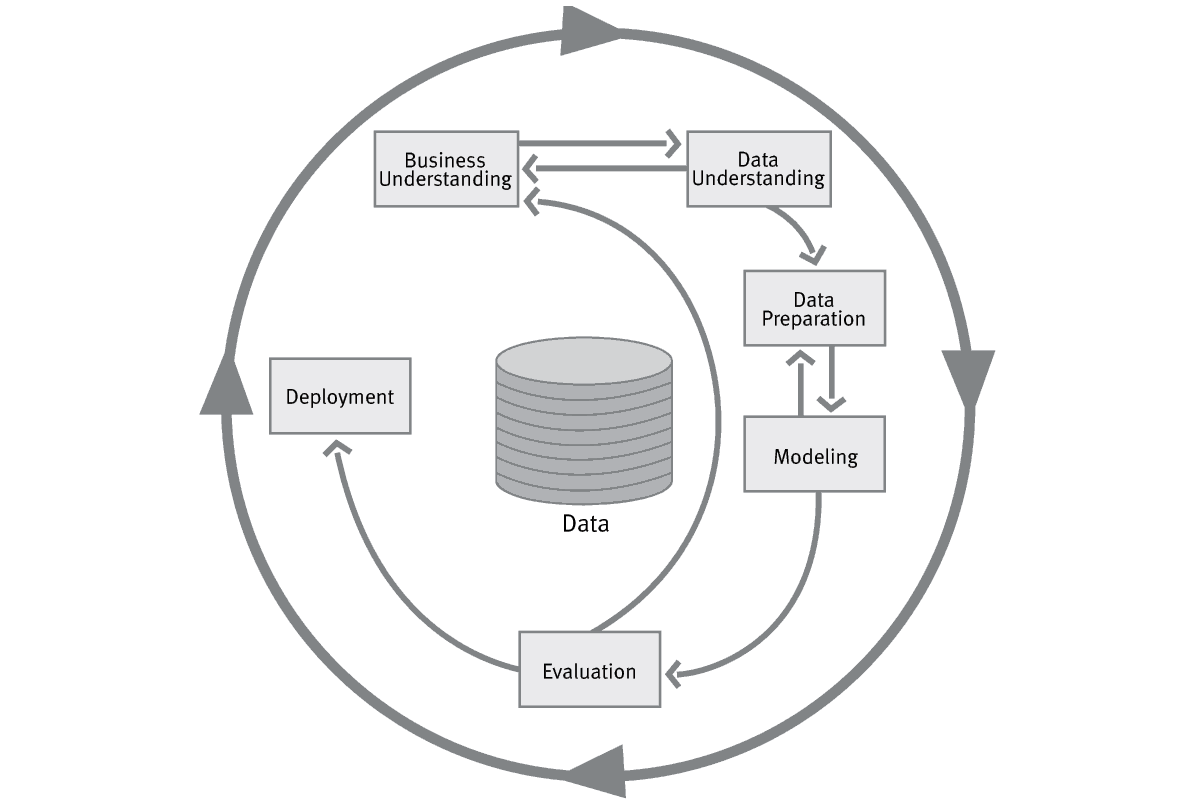 Source: [CRISP-DM: das Standard-Vorgehensmodell für Data Mining](https…
Statistics
- Correlation Coefficients - Pearson, Spearman, and Kendall, when each fits, and why zero correlation is not independence. Related: Exploratory Data Analysis.
- Statistical Inference Basics - p-values, confidence intervals, t-tests with worked examples, business decisions, and Bayesian credible intervals. Related: 1. Probability.
- Autoregressive Models - AR, MA, ARMA, ARIMA, order identification with ACF/PACF, AIC/BIC/HQC and LRT, parameter fitting, and forecasting. Related: Correlation Coefficients.
- Stationarity and Unit Roots - Weak stationarity, types of non-stationarity, ADF and KPSS, spurious regression, and fixes.
- ARMA and ARIMA Models - Lag operator, invertibility, differencing, special cases, and a worked order-identification example.
- Vector Autoregression - Multivariate AR, Granger causality, impulse responses, cointegration and VECM.
Network Analysis
Read in this order: node importance first, then two-mode networks.
- Centrality Measures - Degree, closeness, betweenness, eigenvector, Katz, and PageRank, with a worked example and when to use each. Related: Distributed Machine Learning and Graph Processing.
- Bipartite Networks - Two-mode graphs, biadjacency matrices, one-mode projections and weighting, co-occurrence matrices, and centrality across two node sets. Related: Recommendation Systems.
- Network Analysis Tools - NetworkX for analysis, Gephi for visual exploration, Graphviz for static diagrams.
- Graph Neural Networks - Message passing, GCN, GraphSAGE, and GAT; learned alternatives to hand-made centrality.
- Specification Models as Graphs - Adapter and intermediate-representation pipeline, multigraph construction choices, and rule-based consistency checks on a system model. Related: Model-Based Systems Engineering.
Simulation
- Agent-Based Modeling - Emergence from simple agent rules, Schelling’s segregation model, how it differs from LLM agent systems, and the Mesa framework. Related: Network Analysis Tools, Agents MOC.
Big Data Technologies
Read in this order: foundations, storage and batch compute, then streaming, plumbing, and analytics.
- Big Data Fundamentals and Architecture - The four Vs, layered architecture, storage options, CAP trade-offs, and responsible use. Related: Database Types, Database Selection.
- Hadoop and MapReduce - HDFS, YARN, the map-shuffle-reduce model, and the Hadoop ecosystem.
- MapReduce Patterns - Shuffle internals, Hadoop Streaming word count, combiners, joins, top-N, matrix multiplication, skew and salting.
- Apache Spark - In-memory engine: RDDs, DataFrames, lineage, and how it differs from MapReduce.
- PySpark Cheat Sheet - Tested PySpark reference: DataFrames, joins, windows, UDFs, I/O, performance, MLlib pipelines, feature selectors, and streaming.
- Stream Processing and Event Streaming - Batch vs. stream, Kafka, Storm, Flink, Spark Streaming, and cloud services.
- Big Data Integration and Orchestration - NiFi, Kafka, Flume, Airflow, and Oozie for ingestion and scheduling.
- Distributed Machine Learning and Graph Processing - Mahout, MLlib, Giraph, GraphX, and Neo4j.
- Correlation Drift Monitoring with Spark - Worked predictive-maintenance example: batch correlation matrix, sliding-window streaming correlation, and alerting pitfalls.
- Ray - Python-first task and actor runtime for distributed ML, tuning, RL, and serving; compared with Spark.
External Resources & Data
- Wikimedia Commons - Massive open-source media repository; useful for visual datasets and public domain assets.