In-memory semantic knowledge graph that converts personal documents into topic-aware discovery, visualizations, and reproducible experiment logs.
Quick Facts
- Context: CS584 NLP Knowledge Graph Project
- Tech Stack: Python 3.13+, OpenAI API, sentence-transformers (mpnet), KeyBERT, TextRank, NLTK, NetworkX, PyVis, NumPy, uv
- Links: GitHub Repo | Project Report (PDF)
Overview and Problem
The project builds a lightweight knowledge graph from local documents to improve semantic search and topic discovery. It aims to evaluate different tag extraction strategies and similarity thresholds for optimal graph connectivity.
What I Built
- Engineered an automated pipeline to extract semantic tags using LLM-backed generation (OpenAI API) with statistical fallbacks (KeyBERT, TextRank) and NLTK text preprocessing.
- Implemented embeddings using sentence-transformers (mpnet models) to map tags into semantic space.
- Designed a cosine matching algorithm with configurable k and threshold parameters to link documents to topic centroids.
- Developed NetworkX graphs with interactive PyVis HTML exports and structured text dumps for visualization and debugging.
Architecture overview
flowchart LR
    DOC[Local documents] --> TAG[Tag extraction: LLM, KeyBERT, TextRank]
    TAG --> EMB[mpnet embeddings]
    EMB --> COS[Cosine matching: k and threshold]
    COS --> G[Knowledge graph]
    G --> VIZ[Interactive HTML export]
    G --> LOG[Experiment logs]
Key Results and Impact
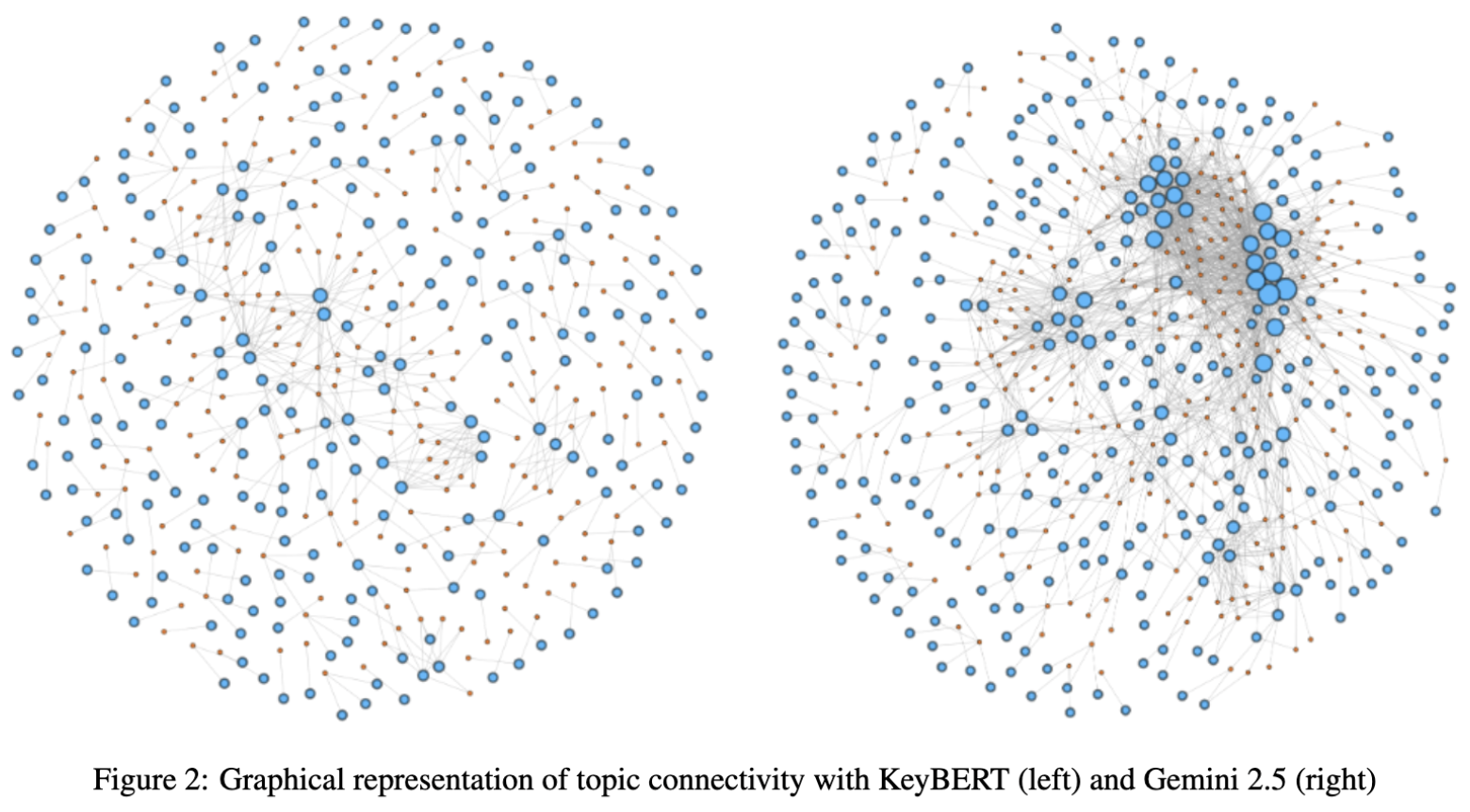
- Achieved best semantic coherence of 0.97 (LLM, k=3, threshold=0.7).
- Reached strongest connectivity with an LCC ratio of 1.00 (TextRank, k=5 or k=7, threshold=0.3).
- Handled dynamic topic counts ranging from 32 to 475 across thresholds, demonstrating a clear granularity tradeoff.
Core Learnings
- Balanced midpoints yielded coherence around 0.77–0.81 with LCC 0.50–0.57 at k=3, threshold=0.5 across different extractors, showing the trade-offs between precision and connectivity.
Related: Projects MOC