Interpolation estimates a value at a position where no sample exists, using the samples around it. Images are grids of samples, so any operation that moves pixels to non-integer positions, such as resizing, rotating or warping, needs it.
Linear Interpolation (1D)
Between two known points and , assume the value changes along a straight line:
The result is a weighted average of the two neighbours. At it is the midpoint. Example: values 10 at and 30 at give at , so .
Bilinear Interpolation (2D)
Interpolate along x on the two surrounding rows, then along y between those two results. The output blends the 4 nearest pixels. With fractional offsets (in x) and (in y) from the top-left neighbour :
def bilinear(img, x, y):
    x0, y0 = int(np.floor(x)), int(np.floor(y))
    x1, y1 = min(x0 + 1, img.shape[1] - 1), min(y0 + 1, img.shape[0] - 1)
    a, b = x - x0, y - y0
    return ((1-a)*(1-b)*img[y0, x0] + a*(1-b)*img[y0, x1]
            + (1-a)*b*img[y1, x0] + a*b*img[y1, x1])
Comparing the Methods
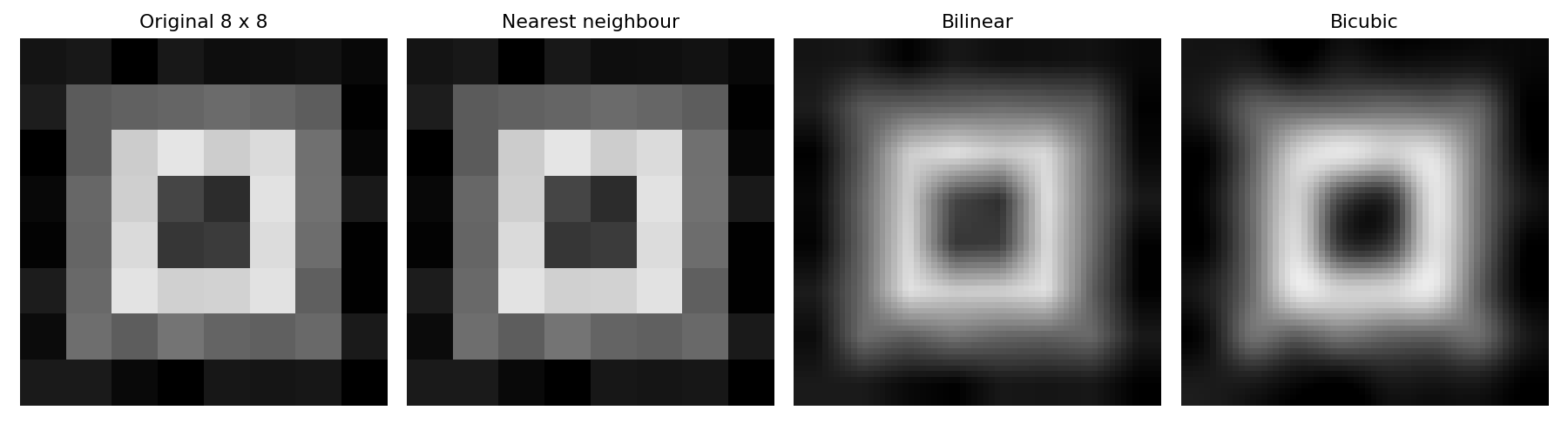
An 8 x 8 image enlarged 8x with three methods.
| Method | Uses | Result | Cost |
|---|---|---|---|
| Nearest neighbour | The single closest pixel | Blocky, keeps exact original values | Cheapest |
| Bilinear | 4 neighbours | Smooth, slightly blurred | Low |
| Bicubic | 16 neighbours | Smoother and sharper than bilinear, can overshoot (ringing) | Higher |
Nearest neighbour is preferred when values must not be mixed, for example label maps where each number is a class.
Resampling in Practice
- Backward (inverse) mapping: to resize or rotate, loop over the output pixels, compute the source position each one comes from, and interpolate there. Pushing source pixels forward instead leaves holes and overlaps.
- Enlarging (upsampling) needs interpolation to fill the new pixels. It cannot add real detail, only a smooth guess. The EXPAND step in Image Pyramids does exactly this.
- Shrinking (downsampling) is different: interpolation alone does not prevent aliasing, so low-pass filter first (Aliasing and Downsampling).
- Interpolation is itself a form of convolution with a small kernel: a triangle for linear, a cubic spline for bicubic (Cross-Correlation and Convolution). Doubling an image is the clearest case: insert zeros between the samples, then convolve with in each direction, which is bilinear interpolation.
Source: Foundations of Computer Vision, ch. 21: Downsampling and Upsampling Images.
Related: Computer Vision MOC, Image Warping, Image Pyramids, Aliasing and Downsampling, Image Representation and Indexing